
Leaving Bread Crumbs for Continued Climate Engagement at Extension
Aaron Wilson; State Climatologist of Ohio; Assistant Professor – Ag Weather and Climate Field Specialist, Department of Extension – CFAES
Since launching Climate Ready Midwest in late 2021, our team has achieved numerous milestones aimed at integrating climate information into Extension’s agricultural programming and strengthening collaboration with the USDA Midwest Climate Hub. Many of these accomplishments have been highlighted in previous Project News updates. We are also excited to share our recently published Journal of Extension (https://open.clemson.edu/joe/vol63/iss4/7/) article on this work with 1862 colleagues.
From the outset, our goal has been to explore climate integration across all Extension types—1862, 1890, and 1994)—and identify common threads. Key insights include:
- From 1862 institutions: The critical role of partner programming and grant support, outreach tools for decision-making, leadership engagement, networking and collaboration, and professional development opportunities.
- From 1890 colleagues: The necessity of coproducing knowledge between Extension educators and producers to address climate challenges within communities of practice. Building trust— and addressing mistrust—is essential for effective climate programming.
- From 1994 Tribal colleagues: Climate programming integration is inherently present in many cases, but a severe lack of resources limits broader implementation.
Together, these perspectives offer valuable lessons for institutions and individuals seeking to integrate climate information into their programming. Equally important, rigorous evaluation at all partnership levels helps clarify effective funding, implementation, and management strategies—strengthening climate programming across the entire Extension system.
Drawing from our work, the project team offers the following recommendations for Extension colleagues, Extension leadership, and USDA partners. We hope these serve as practical guideposts to inform and strengthen Extension’s climate-related efforts in the years ahead.
Recommendations for Extension colleagues
- Engage in Systems Thinking: Leverage physical and social science data and methods (e.g., climate models, causal loop diagrams, and theories of change) to understand the roles that individuals and groups can employ to effectively communicate the complexity of climate topics related to agriculture.
- Build Relationships First: Prioritize relationship-building with communities before launching programming.
- Adapt Language to Local Contexts: Use locally resonant language (e.g., “weather resilience” instead of “climate change”) while maintaining scientific integrity.
- Collaborate Across Institutions: Seek out partnerships with other LGU Extensions, local organizations, and agencies to cocreate programming and leverage existing resources.
- Document and Share Learnings: Contribute to shared learning by publishing, presenting, or blogging about what works (and what does not) in Extension climate programming.
- Leverage Existing Tools: Use tools like the Climate Gardening Activity Guide and Climate Ready Farm to engage learners of all ages. Pair tools with Extension support to maximize impacts.
- Be Responsive to Producer Needs: Recognize that producers may be skeptical or resistant. Use adaptive management and emphasize resilience and profitability to build buy-in.
- Be Aware of Policy Changes That Impact the Work: Thorough understanding of policy changes that affect producers can change rapidly. Be prepared to effectively communicate the challenges and impacts related to these changes.
Recommendations for Extension leadership
- Prioritize Climate Programming Institutionally: Leadership can signal that climate work is a priority by allocating staff time, resources, and recognition to climate-informed programming and support the training and dissemination of tools to all stakeholders. They should support the development of, training on, and dissemination of decision-making tools and other pertinent resources to all stakeholders.
- Create Safe Spaces for Climate Work: Develop internal cultures where Extension professionals feel supported to engage in climate topics.
- Address Staff Turnover and Continuity: Recognize the impact of internal and external (e.g., MCH) turnover on programming and partnerships. Consider succession planning and onboarding processes that maintain momentum in climate work. Integrate tools and new technology into onboarding processes to give all employees exposure to climate programming and how it may fit into their specialty area.
- Support Professional Development: Invest in training and mentorship for Extension professionals on climate science, decision-making tools, and effective climate communication that can address the unique challenges of stakeholders across all Extension institutions.
- Clarify and Strengthen Partnerships: Formalize partnerships with Climate Hubs and other agencies. Clearly define roles, expectations, and shared goals to avoid confusion and duplication.
- Recognize and Incorporate Diverse Expertise: Value the contributions of 1890 and 1994 Extension colleagues as horizontal partners, not just stakeholders. Support their leadership in climate programming.
Recommendations for USDA partners
- Fund Relationship-Building and Pre-Work: Allocate resources specifically for pre-engagement work with underrepresented Extension institutions (e.g., 1994s and 1890s), including time for trust-building, codesign, and culturally grounded approaches. This often cannot be achieved within a single funding cycle (2–4 years).
- Incentivize Structural Change in Extension Systems: Recognize that current systems often inhibit equitable collaboration across 1862, 1890, and 1994 Extension institutions. Funders should consider restructuring project outcomes to better support proactive, trust-based partnerships with flexibility to support diverse stakeholders across institutions. This action must also consider the pre-work recommendation above.
- Invest in Long-Term Capacity: Provide sustained funding for positions (e.g., Tribal liaisons, climate specialists) that can bridge institutions and communities, especially in areas of greatest need.
On a final note, this work has unfolded under two distinct national policy approaches to climate action. While these shifts have recently constrained our team’s ability to fully realize the newly envisioned Extension-USDA Midwest Climate Hub model, they do not lessen the urgency of advancing climate resilience or diminish Extension’s need to deliver critical climate information to stakeholders across the region. In that spirit, I invite all readers to build on these early successes – gather the crumbs, join the table, and help create a feast of resilience for the future.
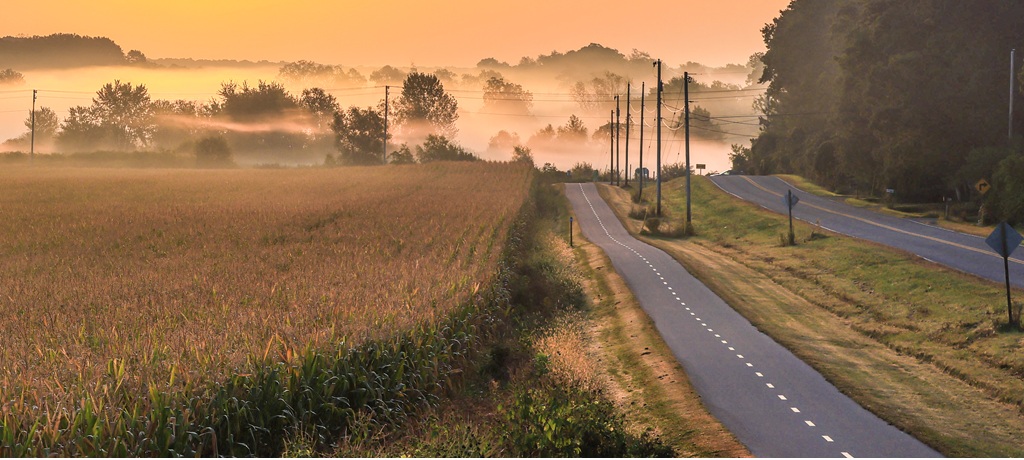
Foggy corn field landscape. PC: Allison Gallipeau
This work is supported by the Agriculture and Food Research Initiative, project award no. 13429389, from the U.S. Department of Agriculture’s National Institute of Food and Agriculture. Any opinions, findings, conclusions, or recommendations expressed in this publication are those of the author(s) and should not be construed to represent any official USDA or U.S. Government determination or policy.